Books

Tuesday, October 4, 2011

The morning was crisp and clear and we got started just after sunrise. We were greeted by the sight of Eagle, the Coast Guard Academy's tall ship, coming into port. (The Academy is in New London.)

It was another day of westerly winds, and so we motored all the way to the Connecticut River, our destination and Monica's final stop on this cruise.
It was mid afternoon when Robin's bow turned between the two jetties at the mouth of the river. I'm always wary of the shoals on either side of the river, always paying careful attention to the boats coming at us ahead and astern, and so I had reason to be studying the dark-hulled sailboat coming downstream toward us.
My mouth was just forming the words: "That looks like Mirari" when I noticed the captain was looking back at me with a smile. It was, indeed, Mirari and her skipper, Dan Stadtlander, he of Bermuda One-Two fame and a friend now for the last four years.
We waved and shouted hellos, and then we each kept on going, certain we'd be talking in the near future.
In a mile or so, we turned to port into North Cove in Old Sayebrook, CT, where we found a mooring with a yellow ribbon, indicating it was free for the taking.
One more splendid evening with Monica, and then in the morning she and I took a taxi to the Amtrak Station, where she boarded a train for New York while I returned to get Robin underway for the final leg of this summer's adventure.
On Wednesday, we had motored most of the way to Stonington, slicing into a headwind much of the time. But today, there was some angle to the wind. At first, we sailed on a beat, crossing Fisher Island Sound on a slant until we were in danger of running aground on the far shore. Then we kicked on the motor and motorsailed much of the way to the Thames River, which separates New London, to the west, from Groton, to the east.
New London is home base for a number of ferries that cross Long Island Sound, and as we approached the mouth of the Thames, we saw a couple coming and going. We knew we needed to be careful.
Soon, we were in the shipping channel, where scores of United States submarines have, since the beginning of World War II, sailed their maiden voyages. (They were built in the shipyard at Groton, which is now home to the Electric Boat division of General Dynamics, builder of the nation's atomic subs.)
Ever observant, we noticed that a ferry was approaching from the south and the Sound while another was just leaving it slip to the north in New London. We decided that the best move would be to cross the marked channel and motor north, to the west side of the green buoys, outside the channel.
The two ferries drew closer and closer. We were glad we made our decision to get out of their way.
Then the outbound ferry slanted to its starboard, clearly aiming on a course that would take it outside the marked channel.
It was headed directly for us, and it was coming fast.
I grabbed the microphone.
"This is the sailing vessel Robin inbound on the Thames River near green bouy (let's say 19) calling the outbound ferry approaching us. Which way are you going?"
There was a slight delay before the voice replied: "South."
That wasn't what I wanted to know. Now we were very close to the ferry's bow. To turn to port seemed suicidal, and so I steered sharply to starboard.
The voice came back on the radio: "I'm giving the inbound ferry more room."
Thanks, we thought. Thanks a lot! Either decision I might have made could have been wrong in the absence of details on which way the outbound ferry was planning to go. As it turned out, I made a lucky choice and the boat raced past our port side perhaps 50 feet away.
This wasn't the best first impression a port could make on a visiting cruiser.
We had decided to take a mooring in the new city mooring field, just south of the ferry terminal, and moments after we passed the rude vessel, we turned to port and into the mooring field. We had called ahead and knew that we were simply to pick up a mooring and then go ashore to settle up. It turned out that the city didn't yet have a harbormaster to deal with transients.
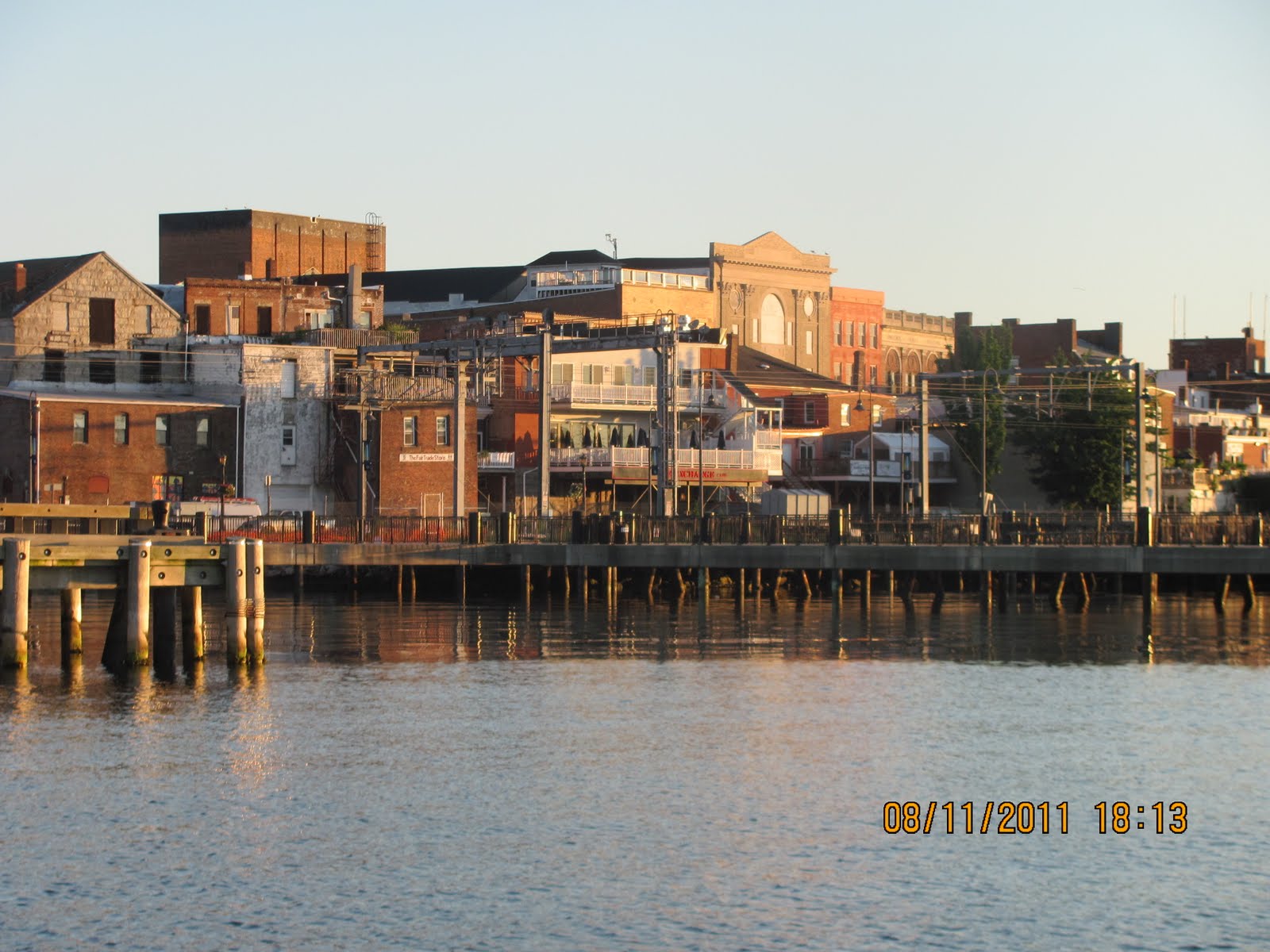
The moorings were big and stable looking, and they were clustered just off the downtown district. From the water, the town looked suspiciously like Gloucester had -- pretty blue collar. With no harbormater and no apparent security, the setup posed some important questions.

I dinghied ashore and met the young lady who collected the fee. Then Monica and I both went ashore for dinner and ice cream. When we returned to the dinghy, we were met by the skipper of another sailboat that had just taken a mooring. He had noticed that our hailing port, lettered on Robin's stern, is Burlington NJ. "I was born in Camden and grew up in Moorestown (where our local Wegman's supermarket is,)" he said.
Small world.
We settled in for our next-to-last night of the cruise, and I wondered whether we'd be visited in the dark by any pirates.
Stonington has all the comforts. There is almost no room to anchor, so taking a mooring from Dodson Boatyard is a prerequisite for a stay in this well-protected (by a seawall) harbor. The staff running the launches at Dodson's was more than helpful. All young men and women, they picked us up, delivered us to a dock in town near a bank (we needed cash) and answered all our questions, all without a fee.
Make no mistake, we paid for the launch in the $45-plus-tax mooring fee, one of the highest we encountered on this cruise. But the kids were nice and good looking, and we later discovered they had been trained by none other than our old friend, Curt Michael, aka The Old Mike
Monica liked the launch drivers. She also liked the cute shops in Stonington. And she liked the one Main Street restaurant that we patronized for both breakfast and a late lunch before we moved on on Thursday for our next stop, New London, CT..
We stayed two nights in Newport. When we arrived, we took a mooring rather than attempt to set the anchor in a crowded harbor during foul weather. But the next day, we slipped the mooring and motored around Goat Island, which separates Newport Harbor on the east from Narraganset Bay on the west. There is a low bridge that connects Goat Island and the Newport mainland, so you can't take a sailboat with a mast directly north from the harbor.
Once around and off the north point of Goat Island, we set anchor in a stiff breeze just outside a small mooring field. Because the wind was from the southeast, we were quite protected by the mainland and the island. Should the wind have veered to the west, we would have been exposed.
But the wind stayed steady throughout the day and into the night, and all the boats on anchor -- a half dozen of us -- rode comfortably.
We were the next to the smallest boat. This one was the smallest.

The boat belonged to a middle-aged woman and two teenaged girls, from our observations. It was equipped for long passages but was not a vessel I'd choose to cross oceans. That may well have been what the ladies had done, however. We never got to find out, because the next morning -- Wednesday -- we left for our next stop, Stonnington, CT, which became Monica's favorite port.

Sunday, September 25, 2011

Saturday began with some wind from the south, so before noon we hoisted our anchors and both Cailte and Robin headed for the Cape Cod Canal. Our course was a bit more westerly than the direct route for the canal entrance, and then the wind veered to the west. As a result, our progress toward our goal was slowed substantially.
In time, both boats were motoring into a brisk headwind. My first time making this particular crossing was aboard Cailte. This time, Robin was in the lead.

Perhaps due to the strong southwesterly breeze, although we entered the eastern end of the canal right on time for the current to change in our favor, we found an adverse current. That lasted a good half way through the canal, and it warned us of rough seas once we exited the canal in Buzzards Bay, a body of water notorious for its southesterly afternoon chop.
That complicated things, because to enter Onset Harbor, within a mile of the western entrance to the canal, requires some rapid maneuvering. If the water was bumpy, that sharp turn to starboard might be dodgey.
For once, I was introducing Tom to something new. He'd never been to Onset in his 29 voyages to Maine. So I had described the Onset entrance in detail: The green tower on a pile of rocks that marked the near end of the entrance, the green can just beyond that marked the far end, and the currents that sawed in opposite directions within a few feet and that tried to shove your bow onto the rock pile.
I radioed Tom just before we reached the entrnce. Fortunately, we were through the worst bucking that the Buzzards Bay breeze created on the ebbing current.
I made my sharp turn into Onset and, glancing quickly so as not to lose my bearing, I looked back to see Tom, his teeth gnashing as Cailte went through the Onset Waltz.
We both anchored outside the mooring fields of a marina and a yacht club, and the next day all of us went ashore for dinner with my relatives, Betty and Ted Campbell, who live nearby, and with my sister, Janet, and her husband, Dennis.
On Monday, we parted company with Tom, who waited for the arrival of his brother, Mike, to help him take Cailte back to New Jersey. It was another day of motoring, but one punctuated, when we arrived off Newport, RI, our destination, with a fanfare of lightning and thunder that escorted us into Newport Harbor.
The next morning, we were encumbered by a schedule when we motored out through the Gloucester breakwater and headed toward Provincetown, about 40 miles to the southeast. We wanted to be in Onset, at the far end of the Cape Cod Canal, on the next day, Saturday, so there was no chance of waiting for wind to blow us there.
The Sea was slick as oil, with gentle swells, and in the sky sunshine filtered through thin clouds.
We reached Race Point -- the northern tip of the Cape -- at mid afternoon and rounded the southern tip of the hooked beach off Provincetown an hour or so later. The beach was remarkably unpopulated.

It's about three miles from the tip into Provincetown Harbor, where we expected to find Tom Gilmore's boat Cailte anchored. We spotted her from a mile away and made straight for her, anchoring about 150 feet to her north. Later, Tom joined us in the dinghy for an examination of the Provincetown wildlife, which is mostly nocturnal. After dinner and ice cream, we dinghied back through an anchorage dotted with derelict-looking craft that may well have been occupied dwellings.

Monday, September 5, 2011

Out at the York, ME, sea buoy, the wind was blowing.
Hallelujah!
With the Autohelm 4000 doing the steering, we sailed all day long, reaching Cape Ann, MA, by 3:30 in the afternoon, a voyage of 35 miles. The wind had been from the northeast, on our port quarter until we were just offshore from this new cape and about six miles from the entrance to Gloucester Harbor. It had been the perfect day.
But now we had to turn to starboard to make a straight run for the Gloucester breakwater -- and a run it was, with the wind directly from behind along with a following sea that wanted to shove Robin's stern one way or another.
The smart move would have been to keep on a reach until we had the breakwater on our beam, and then to tack toward shore.
Instead, when the action got rough, I brought the sails down and motored for the next hour.
We had called ahead for a city mooring in Gloucester, a port we'd never visited. I grew up in Massachusetts but had never been in downtown Gloucester, a town that played a central role in the book (and movie) The Perfect Storm. It was that book that helped sell me on the Westsail 32. One Westsail had been caught in the storm and easily survived, and that convinced me this was the boat for us.
So our visit to Gloucester seemed in a sense preordained.
There was a drama going on when we reached the breakwater. A sailboat had sunk just off the entrance, and crews were attempting to raise the boat. We went around the two boats on the scene and motored up the outer harbor, about two miles long, while three guys in an old Irwin 30 made us look like neophytes, sailing along with Robin as her exhaust spit out water and steam.
The harbormaster met us when we were inside the inner harbor and led us to a mooring, collecting his fee and offering suggestions for our visit.
But we decided to stay aboard Robin. The dinghy was lashed on the foredeck, there was food in the icebox and we'd had a wonderful day on the water. Why not stay there?

The boats moored near Robin made clear this was a working harbor. This lobster boat, rather trashy looking, was not quite as picturesque as those we'd seen in Maine.

Nor was this commercial fishing boat going to win any councours d'elegance. There was not a waterfront mansion in sight . . .

. . . only blue collar tenaments. With no glitz to lure us ashore, we had dinner, read our books and watched the sun set behind a cathedral that stood on the far side of not some fancy waterfront bistro but a steel-sheathed warehouse on a barnacle-encrusted wharf, just north of the harbor's Coast Guard station.

With darkness came sleep. Monica was in the V-berth, where there really is only room for one, particularly if one needs to make middle-of-the-night visits to the head. I was in the main cabin on the starboard settee.
It was about 10:45 p.m. when I woke. I saw Monica, only a shadow, up in the cockpit, moving around.
Why is she out there, I wondered? The night was pleasantly cool, and Monica seldom wakes once she falls asleep.
Then she began fumbling with the companionway screens.
"What are you doing?" I asked. I couldn't imagine why she had gone to the bother to replace the screens if she went out to get some air.
She hadn't.
I knew this now because there was a flashlight shining through the screen into my face.
As I climbed over the lee cloth and out of my berth, the shadowy figure moved to starboard. A moment later, I was standing on the companionway ladder, fumbling with the screens.
Just beyond the dodger, two feet away from me, a large man was attempting to climb over Robin's two-strand lifeline.
Then I saw the boat and the other man. The boat was small as was the other man.
It was still confusing me, what was happening, so at first I didn't realized that the man in the boat was trying to start an outboard motor, maybe flooding the engine.
There was nothing I wanted more for the big man to climb over the lifelines. And now there was nothing I wanted more than for the outboard to start.
But I was also now aware that we had been boarded by thieves, and I was angry. Although they hadn't been aboard long enough to take anything, I didn't want them to get away with their felony.
So I reached down inside the companionway where two headlamps are hung by their straps over a regular flashlight mounted there. I seized one of the headlamps, brought it up, turned it on and shined the light at the bow of the theives' boat, where I could read their registration number. I tried to memorize it.
MS 0106, I thought.
"We've got a gun," the scrawny man operating the boat hollered. "Don't come any closer or we'll use it."
I had no intention of getting any closer. But now I was forced to think about our vulnerability if the invaders really had a gun. We were unarmed, I thought, and I got the feeling in my chest you might get staring down the barrel of a loaded pistol.
I kept the light shining on the boat, and finally the outboard motor caught and the boat began to ease in reverse away from Robin's side.
When the scrawny guy -- he reminded me of the rock star Kid Rock -- got the boat far enough aft, he motored slowly past Robin's transom. I stared into his eyes, the flashlight still shining on the boat.
"Don't try to follow us," Kid Rock said. "Or we'll come back and get you."
I realized now that he was the brains of this nincompoop operation. I also saw now that the boat was a center console about 16 to 18 feet long and that, on a tall antenna amidships, it flew -- a Jolly Roger, a pirate's flag.
The thieves motored west, toward the cathedral, and then south, near the Coast Guard station, which I was now calling on Channel 16.
"This is the sailing vessel Robin calling the Coast Guard or any law enforcement agency in Gloucester Harbor," I said, and then waited.
It was probably 15 seconds later that a young woman Coast Guard watchstander responded. I described what had happened and the culprits. She asked for my cell phone number and the called me.
The watchstander told me that a 25-foot Coast Guard boat was being dispatched to investigate.
By now, Monica had been awakened by the commotion and was standing on the companionway ladder while I stood in the cockpit, watching the thieves circle the harbor, heading now east and stopping in what I thought was called Smith Cove. Once again, the big guy's flashlight came on, bobbing about as if he had boarded another boat.
"I can tell you where they are right now," I told the watchstander.
Moments later, Monica and I saw the red and green lights of the 25-footer emerge from the darkened Coast Guard station and move slowly across the harbor, heading toward the flashlight.
Half way there, the red and green navigation lights disappeared, but we could see the silhouette of the 25-footer advancing toward the thieves.
Suddenly, a blue police light was flashing and a flood light or spotlight was piercing the darknessand we heard excited voices.
It was a few minutes later that we got another phone call, this one asking whether the Coast Guard could bring the culprits by for my identification.
Of course, I said.
The Coast Guard had the center console cleated alongside the 25-footer, and two Gloucester City police officers were in the center console, where Kid Rock was handcuffed in his pilot's seat and his beefy sidekick was in the bow facing aft, handcuffed.
The police sergeant asked if I could identify the suspects. Yes, I said. Pointing to Kid Rock, I said: "He was driving and he made the threats." Then I pointed to the big one and said, "He came aboard."
The sergeant turned to the big one and said: "What do you have to say to that?"
"I swear on my childrens' graves, I never was on that boat," he said.
"Shut the f... up," the sergeant said. Then he looked down to the deck of the boat, turned and, directing his next question to Kid Rock, he asked: "You have a permit for those lobsters?"
The two were locked up that night. Kid Rock was wanted on outstanding warrants. They both were charged with breaking and entering a vessel at night, which apparently is a federal offense. They were also charged with threatening bodily injury during the commission of a felony and threatening a witness during the commission of a felony.
Monica says she never wants to return to Gloucester.
I thought it was a much better time than reality television.
By the way, the thieves were captured at a place called Pirate's Point.