It's election day, an interesting time when, as I've been, you're reading Henry David Thoreau. I started reading Walden, Thoreau's alleged masterpiece, several weeks ago, giving it the same intense attention that a Russian weight-lifter gives the kilograms on his shoulder. Truth is, I'd started reading Thoreau several times before and never could keep from falling asleep. I had trouble stringing two paragraphs together before my eyes crossed. So it was with great resolve that I attacked him this time around. Now I'm about two-thirds the way through Walden, and the notes that I've been keeping on the inside back cover are developing into quite a long list. I guess in earlier attempts, I didn't recognize that I was dealing with a philosopher and so wasted time trying to understand the plot.
In any case, the book I have is a small anthology of Thoreau's writing. A couple of days ago, I opened it not to Walden but to an essay titled: Civil Disobedience. Here, Thoreau uses his personal experience getting thrown into jail for refusing to pay his poll tax to discuss a citizen's responsibility toward the government.
Thoreau had resisted the tax because he didn't want to fund a government that supported slavery. He lived in Massachusetts, but Congress had recently enacted the Runaway Slave Act, which required any state to capture and return to their "owners" slaves that had managed to escape. Thoreau said he refused to support such a government.
That started me thinking whether there were any laws that our current government enforces and with which I have bedrock disagreement sufficient to draw me into an act of civil disobedience.
There are two. One is the law allowing capital punishment. The other is the collection of laws prohibiting the sale and use of certain drugs.
Briefly, I am opposed to capital punishment because I believe that it fails in its stated purpose -- discouraging the commission of certain crimes -- but that it succeeds in promoting one of our lowest impulses as human beings -- revenge. Hangings and beheadings in earlier times drew great crowds filled with no higher moral impulse than bloodlust . Executions are now more private and more sterile, but they still feed our lowest instincts. I don't think that humans are necessarily perfectable. But I don't see it as my government's role to to encourage such low values, either. Why, I ask myself, is it illegal for me to crush my neighbor's skull with a rock but fine for me and my fellow citizens, with my government's blessing, to stone someone to death? The one is no more moral than the other.
I could go on arguing about morality, and at some point I probably will.
But for the second issue: The War on Drugs and the laws that justify it, again briefly, the nation tried the same policy when it came to the use of alcohol. Prohibition, as it was called, did nothing to dampen society's thirst for a drink. What it did do was create a business for those individuals ruthless enough to take advantage of the law and to provide the populace with their drink. And, of course, Prohibition created an industry of law enforcement -- an industry with a guaranteed future and many advancement opportunities for police officers, judges, lawyers and jailers.
We ended Prohibition for a reason. It didn't work. But we had this "infrastructure" with little to do and so we decided to come down hard on another source of addiction. (Sure, that's simplifying a difficult situation. Drugs cause great tragedies in people's lives. But as my father, Archie Campbell, always said: You can't legislate against vice.)
Archie had another favorite saying: My country, may she always be right. But right or wrong, my country.
When I was younger, I equated that sentiment to a responsibility for blind support of one's country and the government directing the fortunes of its citizens.
Then along came the Vietnam War, and I started to wonder.
And now comes Thoreau, and I feel called upon to express to my fellow citizens the wrongness I see in capital punishment and in the drug laws.
I've checked in the dictionary for definitions of a couple of words. There's "republic" and "allegiance" and "pledge". And I've decided that one's higher calling, above allegiance to one's nation and its government, should be allegiance to what you perceive as truth. Because when the population lives by truth and charity toward one another alone, it may be that government is unneeded.
From this point on, I will pledge my allegiance to truth and nothing less.
Tuesday, November 6, 2012

Monday, November 5, 2012
Saturday, we attended the fall skipper's meeting for the Bermuda 1-2 in Newport, Rhode Island. If we can find the resources, we will enter that race in 2013. I've made it my priority to do that, and spending time talking with other skippers helped me cement the idea into a commitment. I'll sail to Bermuda next June. Monica will meet me there and we'll sail back to Newport together, just as before.
In anticipation of getting to the starting line on time, I've decided to bring Robin north sooner than the December date I'd chosen. (There was another motivation -- Monica doesn't want to sail on into December -- which I'd like to do -- so there's no point leaving Robin in the water.)
The resources we'll need amount to money. We need to have the entrance fee, now at $500. We need to get our life raft recertified, another big expense. And then there are other items on the list that I'd like to have for the race: A new staysail and an antenna and a ground for the single side band radio I bought last year top the list.
On Sunday, on our way out of Newport, we swung by the Newport Shipyard to inspect some of the megayachts docked there. Below are photos of some of these boats, for which Robin wouldn't quite make it as a dinghy. The first one, although you can't see it,has a speedboat stored in its transom for use as a tender.Another is parked on the far side of, and dwarfing, a Swan 42-44, I think.
These boats are apparently mere trifles for their owners, who have left them in cold Newport when they might be sailing in the islands. Every one of these vessels, except the third one, appears to be well over 100 feet long.


Thursday, November 1, 2012
Dan Stadtlander, our friend from the Bermuda 1-2, found the flaw in my earlier complaint about things coming unscrewed at the boat club. Specifically, he said:
"If the bolts are vertical wouldn't the rising waters force the timber up against the bolts and force them up? Vibrations set up in the timber and bolts by wind and surf can then vibrate the fasteners causing them to walk up. But I do like the idea of a mischievous spirit playing with your bolts and nuts!"
Thanks, Dan, for the cleansing analysis. I'm sure there is a similarly simple explanation for the shackles becoming unscrewed (without mentioning the fact that I could have wired them in place.)
But I, too, did like the thought of mysterious forces at work.
Wednesday, October 31, 2012
In an earlier post, I described how a shroud on Bluebird had become detached from its chainplate during a sail. On Friday, when I went out to bring Bluebird ashore in advance of Hurricane Sandy, I discovered that the same shroud on the opposite side had become detached. I had checked and tightened that attachment when I found the first shroud flying, so I was puzzled.
Yesterday, I helped dislodge some large logs that had been washed by the flooding river up on the rails on which we launch boats at the Red Dragon Canoe Club. There were a half dozen tree-sized logs tangled between the rails and the steel pier that extends out to the floating docks.
When the work was done, we noticed a landscaping timber lying in the parking lot up where debris marked the high water level from the flood. And then we saw the two bolts, bedded in concrete at the edge of the parking lot bulkhead, from which the landscaping timber had been floated.
The timber had been secured on those bolts by two nuts. Clearly, the nuts would not normally have twisted themselves u[ward off the upright bolts. Gravity, if anything, would have caused the nuts to tend downward on the bolt threads.
So there seems to be a mystery there on the Delaware involving the disengaging of threaded fasteners. I'm not suggesting anything like the Bermuda Triangle. But the sequence of events is troubling to a mariner.
Tuesday, October 30, 2012
Sandy came, went and left a message.
 You can't dodge every bullet.
A pin oak with a base nearly four feet in diameter toppled onto our deck at about 10:30 Monday night. We were asleep. The sound was that of a dump truck loaded with gravel falling beside your bed. We were both asleep and came to with the same "What the . . . " cry.
We were very lucky. The tree could have fallen on our bedroom and crushed the roof. Instead, it missed the corner of the house by about a foot.
One branch punctured the roof above the kitchen. When I came downstairs at 4 a.m. to quiet the pups, I heard a dripping and found that the roof was leaking directly into the kitchen sink! Could we be any more lucky?
I put a temporary patch on the hole in the roof after daybreak. We'll wait to deal with the tree until the insurance company has had a chance to inspect it. I suspect the entire deck will have to be replaced because it's sagging under the weight of this impressive tree. There is one hole punched through the deck boards -- about a foot square -- and if you look down on it you can see the broken end of the branch that made the hole, only slightly smaller than the hole itself.
The power came back about five o'clock after being out for about 22 hours. There was very little inconvenience caused by this. It drove us to play a full round of Mexican Train domonoes.
The first report from Maryland indicates that Robin survived intact. The same is true of all our friends' boats, apparently.
The bullet only winged us, and we sail on.
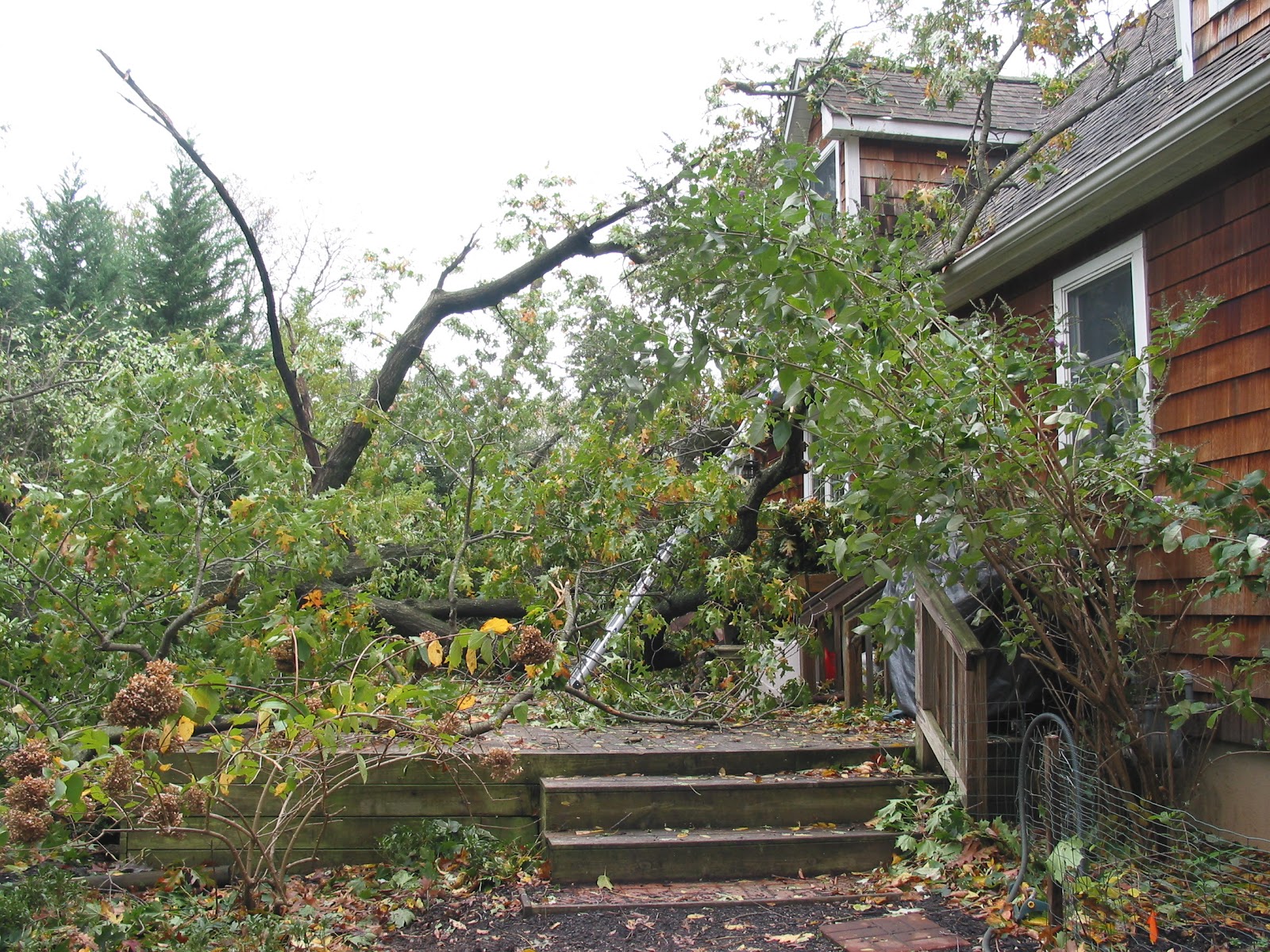
A pin oak with a base nearly four feet in diameter toppled onto our deck at about 10:30 Monday night. We were asleep. The sound was that of a dump truck loaded with gravel falling beside your bed. We were both asleep and came to with the same "What the . . . " cry.
We were very lucky. The tree could have fallen on our bedroom and crushed the roof. Instead, it missed the corner of the house by about a foot.
One branch punctured the roof above the kitchen. When I came downstairs at 4 a.m. to quiet the pups, I heard a dripping and found that the roof was leaking directly into the kitchen sink! Could we be any more lucky?
I put a temporary patch on the hole in the roof after daybreak. We'll wait to deal with the tree until the insurance company has had a chance to inspect it. I suspect the entire deck will have to be replaced because it's sagging under the weight of this impressive tree. There is one hole punched through the deck boards -- about a foot square -- and if you look down on it you can see the broken end of the branch that made the hole, only slightly smaller than the hole itself.
The power came back about five o'clock after being out for about 22 hours. There was very little inconvenience caused by this. It drove us to play a full round of Mexican Train domonoes.
The first report from Maryland indicates that Robin survived intact. The same is true of all our friends' boats, apparently.
The bullet only winged us, and we sail on.
Sunday, October 28, 2012
Sandy, be she a hurricane when she arrives or a tropical storm or a mere meteorologic event, prompted me yesterday to visit Robin in Maryland. In a small breeze, I removed her Genoa, took the staysail in its bag off the foredeck, stripped the dodger frame of its canvas, bound the mainsail tightly inside its sail cover, removed all loose obects from the deck, checked the dock lines and shrugged.
About 60 years ago, when my family was camping in Baxter State Park in Maine, a storm that had been a hurricane was approaching. The water it later dumped on Mount Katahdin rolled huge boulders down Katahdin Stream and washed out a crib-work dam in the campground.
The campground ranger, Fred Pitman, a tall, lanky man probably in his 60s -- tall and strong enough to lift over his head a 55-gallon steel drum filled with trash to empty it in his pickup -- was talking with my father about the impending natural disaster. My father remembered for the rest of his life what Fred said, words to the effect: "Hurricanes, storms, blizzards. Ain't much you can do 'bout 'em. No point worrying 'bout 'em."
That's where we are today. Letting Sandy come. I hauled Bluebird from the river on Friday afternoon. She's strapped on her trailer, mast down.
A strong enough wind visits Maryland or New Jersey, things can happen.
 Right now, we've brought Zippy, the cat, indoors, much to his displeasure. He's washing his paws in a yellow wingback chair. Lexi and Samantha are on the livingroom couch. Monica is watching the pre-game show on ESPN, preparing herself to knowledgeably watch football, and I'm going to catch up on some reading and watch the wind rise. I hope everyone else is secure and ready to enjoy the storm.
About 60 years ago, when my family was camping in Baxter State Park in Maine, a storm that had been a hurricane was approaching. The water it later dumped on Mount Katahdin rolled huge boulders down Katahdin Stream and washed out a crib-work dam in the campground.
The campground ranger, Fred Pitman, a tall, lanky man probably in his 60s -- tall and strong enough to lift over his head a 55-gallon steel drum filled with trash to empty it in his pickup -- was talking with my father about the impending natural disaster. My father remembered for the rest of his life what Fred said, words to the effect: "Hurricanes, storms, blizzards. Ain't much you can do 'bout 'em. No point worrying 'bout 'em."
That's where we are today. Letting Sandy come. I hauled Bluebird from the river on Friday afternoon. She's strapped on her trailer, mast down.
A strong enough wind visits Maryland or New Jersey, things can happen.

Subscribe to:
Posts (Atom)
